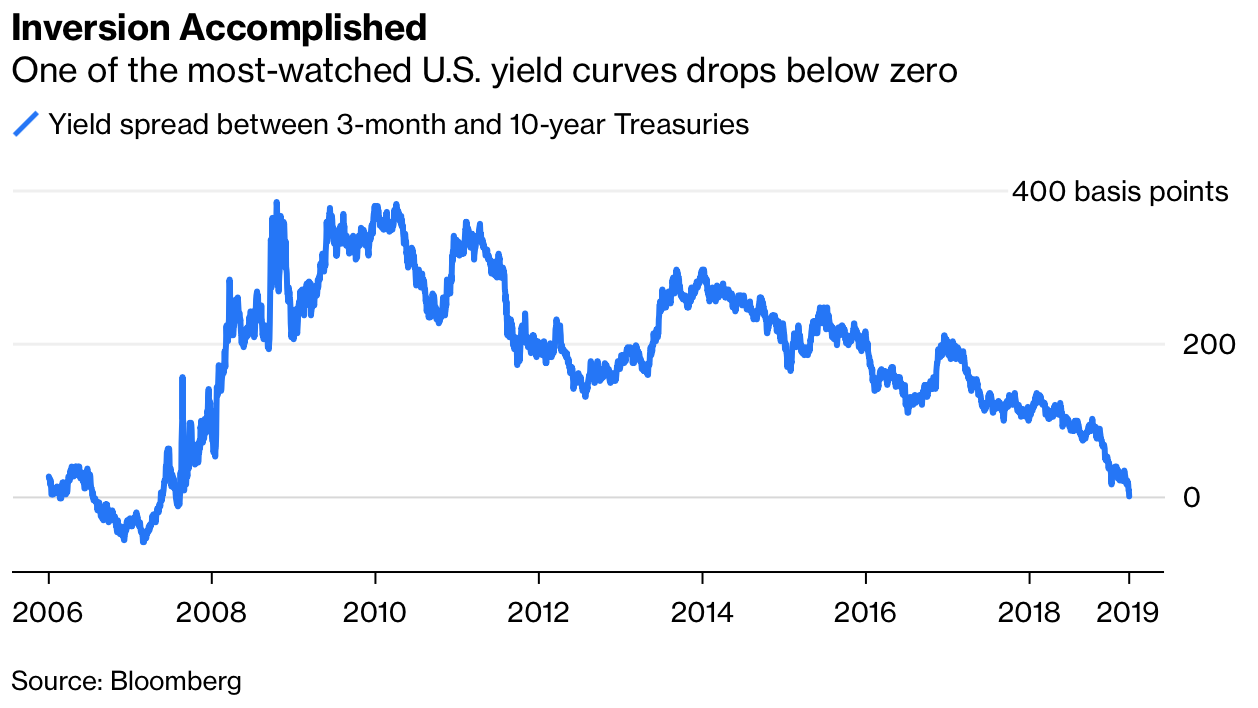
Brace yourself: a recession in the US is approaching. At least, if we go by the benchmark indicator for a recession. The yield curve inverted last Friday: for the first time since 2007, the US ten-year yield fell below short-term rates.
Historically, this is often the signal that a recession is imminent. In the past, an inverted yield curve in 1982, 2001 and 2008 was followed by a recession. On Friday, after the yield curve inverted, US financial markets closed with heavy losses. The Dow Jones index fell 1.8 percent. The broad S&P 500 lost 1.9 percent and the Nasdaq dropped no less than 2.5 percent.
Europe
It is not only in the United States that figures show the economy is cooling. Last Friday we also saw that industry in Europe is faltering. Last Friday, the German ten-year yield fell below 0 percent for the first time since October 2016. The German ten-year bond is regarded as one of the safest investments in the world.
Industrial activity in Germany also fell sharply. The German PMI, which measures the activity level of purchasing managers in the manufacturing sector, came in at 44.7, its worst reading in 7 years.
"Things are really moving very fast now"
"Things are really going downhill very fast now. It indicates that we are heading for significantly lower growth. Growth is dramatically low in Europe in particular; in the US it was not too bad, but the latest signals (there) have weakened as well," said analyst Corné van Zeijl.
Analysts note that once the yield curve inverts, it often takes 9 to 12 months before the crisis is truly felt by consumers and businesses.
Goudverzekerd uses cookies for an optimal shopping experience and security.
With your consent we also place cookies for anonymous analytics and loading external media (videos).
You can change your choice at any time via the .
Read more in our privacy policy.
Functional cookies
Always active — cart, session & security
Cookie settings
Functional (required)
Session, cart, CSRF protection and login status. Always active, no consent required.
Analytics
Anonymised statistics about page visits and website usage. No personal data is stored or shared.
Marketing
Personalised ads and remarketing via external parties such as Google and Meta.
External media
Videos (YouTube, Vimeo) and maps. These external parties may place their own cookies.