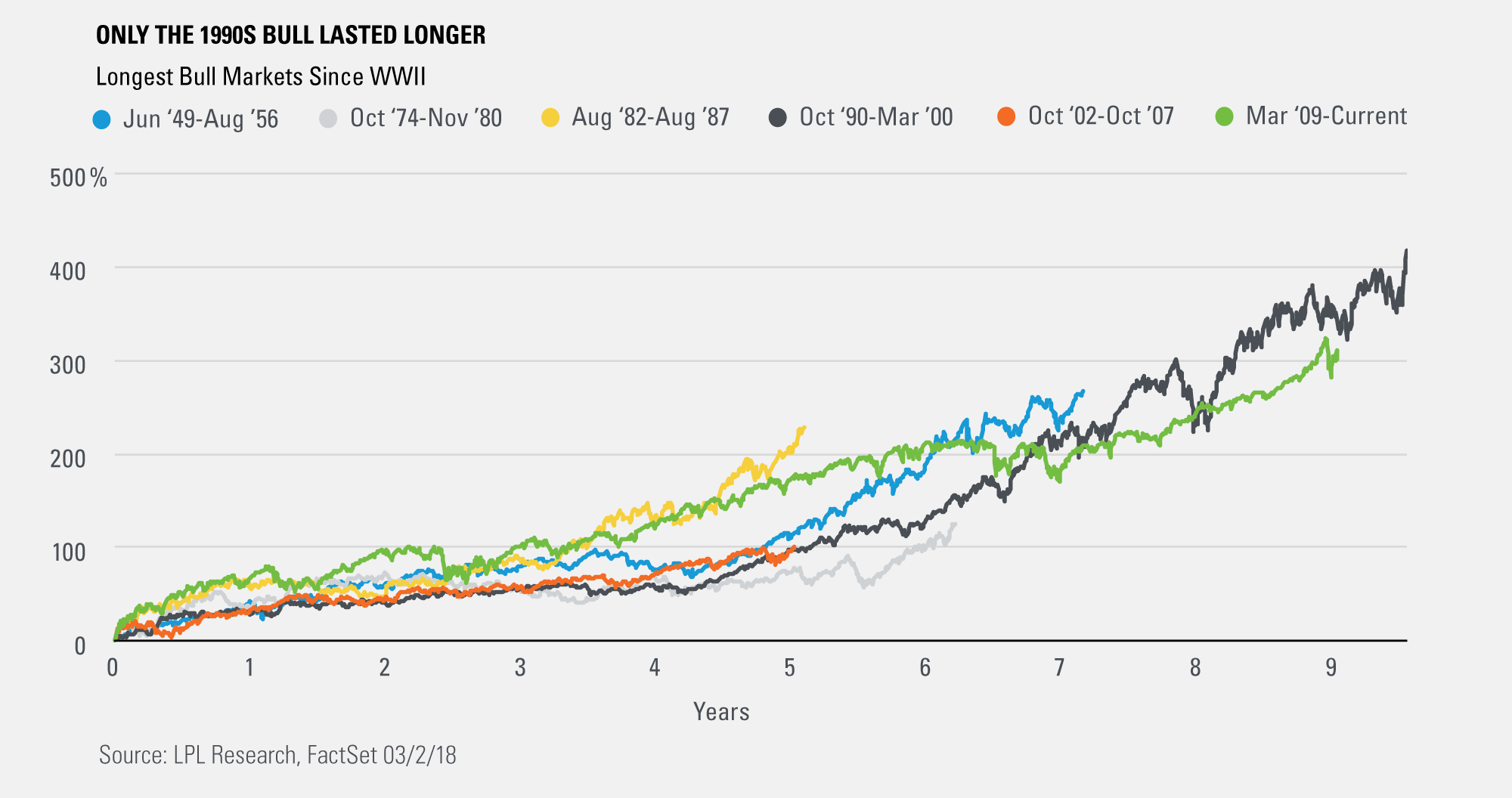
During the longest bull market in modern history, the S&P 500 rose by no less than 418% in 9.5 years, between November 1990 and March 2000.
This era is also known as the ‘Great Expansion’, a time when job growth was robust, oil prices fell, oil stocks rose, and making money was so easy that you only had to put it into the stock market to be guaranteed a return.
Within a few months, however, the Great Expansion could be dethroned as the longest bull market of modern times. According to an analysis by Visual Capitalist, the current bull market, which began in March 2009, will overtake the Great Expansion in August this year.
Ranking the bull markets
The table below shows every bull market since the Second World War.
Ingesloten content
To load this content you need to give consent for external media cookies.
By looking at duration, total return and annualised return, we can compare the bull markets more effectively. The run of the current bull market, which will soon be the longest, does not have the same intensity as the other bull markets. Critics argue that the most recent bull market has been artificially propped up by ultra-low interest rates, quantitative easing and other government actions that will ultimately make the market less robust in the future.
How did each bull market come to an end?
The market psychology behind rising and falling markets is fascinating. Below we look at the events in our history that brought each bull market to an end, although it is really the actions of investors that ultimately dictate the direction in which the market moves.
1. The Great Expansion
This bull run lasted 9.5 years and finally came to an end when the dotcom bubble burst. From June 1999 to May 2000 the Fed raised interest rates six times, trying to engineer a “soft landing” for the stock markets. Uncertainty in the financial markets was compounded by the 9/11 attacks.
2. The Post-Crisis Bull Run
Still ongoing...
3. The Post-War Boom
This boom took place after the Second World War and ended in 1956. According to analysts, the reasons for the end of this bull market were the launch of Sputnik, President Eisenhower's heart attack and the Hungarian Revolution.
4. That '70s Growth
The Iranian Revolution, the 1979 energy crisis and the return of double-digit inflation were the factors blamed for the end of this bull market.
5. Reagan Era
This bull market had the highest annualised return (26.7%), but the party ended on Black Monday in 1987, one of the most notorious market crashes ever. Some of the causes cited for the crash: programme trading, overvaluation, lack of liquidity and market psychology.
6. The Hot Aughts
Stocks did quite well during the era of cheap credit and rising house prices. However, the financial crisis brought an end to this growth, pushing the Dow Jones Industrial Average down from 14,000 points to below 6,600 points.
Goudverzekerd uses cookies for an optimal shopping experience and security.
With your consent we also place cookies for anonymous analytics and loading external media (videos).
You can change your choice at any time via the .
Read more in our privacy policy.
Functional cookies
Always active — cart, session & security
Cookie settings
Functional (required)
Session, cart, CSRF protection and login status. Always active, no consent required.
Analytics
Anonymised statistics about page visits and website usage. No personal data is stored or shared.
Marketing
Personalised ads and remarketing via external parties such as Google and Meta.
External media
Videos (YouTube, Vimeo) and maps. These external parties may place their own cookies.