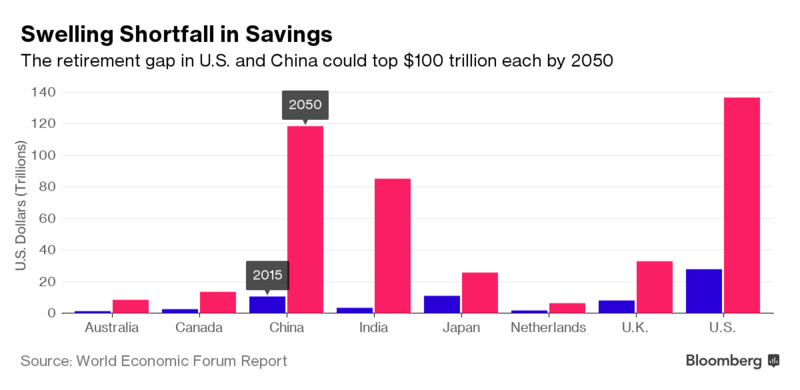
The pension systems as we know them have reached breaking point. Not just in the Netherlands, but in various parts of the world. Low interest rates, slow economic growth and an ageing population are putting future pensions at risk.
This week we wrote about the fact that Dutch pension funds invest only a small portion of their total assets in the Netherlands. A large part of their assets is invested abroad, with all the risks that entails. This week it also emerged that the ECB has extended its monetary easing programme by nine months, which in principle means that interest rates will remain low for a long time to come. Bad news for pension funds.
Elsewhere in Europe (and in the world), pension funds are also in a (particularly) poor state. Below is an overview of the European countries.
The United Kingdom
The United Kingdom currently has a pension savings gap of $4 trillion, which is expected to grow by 4% a year and reach $33 trillion by 2050. The UK has a total GDP of $3 trillion. In principle, this means the shortfall is currently larger than the entire economy, and even with modest inflation the problem will only get bigger.
Moreover, these calculations were made before the United Kingdom left the European Union. Brexit is a major economic shift that could change the outlook for pensions. It is not yet known whether this will be for better or for worse.
In addition, a study by the OECD shows that, once retired, Britons can expect to receive only 38% of their salary. After Mexico and Chile, this is the lowest figure in the world.
This also means that Britons themselves will increasingly have to save more so as not to see their income drop dramatically in retirement. A British think tank recently calculated that young employees need to set aside 18% of their annual net salary in order to have “sufficient” pension income later on.
Switzerland
The world often has a romantic image of Switzerland. Many people think the country is the benchmark for fiscal discipline. To some extent this is true, but like every other country, Switzerland has its problems. The Swiss national pension plan is running deficit after deficit because of an ever-ageing population.
Last month, Swiss voters rejected a pension reform plan that would have strengthened the system by raising the retirement age for women from 64 to 65. Taxes would also have been increased and an employee contribution made compulsory. However, the plan was defeated when 52.7% of voters voted no.
The outcome in Switzerland reflects the attitude of the entire developed world. Reaching compromises is always difficult. Politicians and voters alike ignore long-term problems and often look no further than the next election.
Deep problems: France, Belgium, Germany, Austria & Spain
France, Belgium, Germany, Austria & Spain are in an even worse position. These are ‘pay-as-you-go’ (PAYG) countries. This means that no money is set aside for future pension obligations. The money for pension payments has to come out of the general budget each year.
The crisis awaiting these countries is fairly predictable: the number of pensioners is rising, so more and more money from the annual budget has to go to pensioners. An unsustainable situation.
Spain, for example, was hit hard during the 2008 financial crisis. Nevertheless, the country had gradually built up a reserve fund since the end of 1990. In 2011 the reserve fund held €65 billion. This reserve fund has been completely exhausted to cope with the financial crisis and pension payments. The cause? There are currently 1.1 million more pensioners in Spain than ten years ago. On top of that, youth unemployment of 25% means that less money is flowing into the treasury, making it even harder to meet future obligations.
The Wall Street Journal recently published a report on pensions in Europe. It showed that Europe’s retired population is the largest in the world, and will keep growing. According to the WSJ’s calculations, there are currently 42 pensioners for every 100 workers. By 2060 this figure will rise to 65 per 100 workers.
And unlike most of Europe’s financial problems, this is not a North vs. South issue. Austria and Slovenia, together with Greece and Poland, face the most difficult demographic challenges. These countries have seen many of their young people leave for other prosperous European countries, while the population that remains keeps getting older.
The outlook for the future is also downright bleak when you look at Europe’s birth rates. Since 1960, the birth rate has fallen by 40% to around 1.5 children per woman, according to UN figures. Over the same period, life expectancy has risen from 69 to 80 years.
The coming pension storm
We could go on endlessly about other countries in Europe, but we hope the bigger picture is starting to become clear. The coming pension crisis is not merely a crisis for which current politicians are to blame. It is the result of decades of poor government policy.
For generations, politicians have convinced the public that their (pension) rights are guaranteed. To this day, many politicians still believe this. They have made promises that are unsustainable, simply because they assume that something like a pension crisis cannot possibly happen.
But sooner or later reality will sink in for them too, and everyone will have to make major sacrifices. Everyone will have to work (even) longer, retirement will be shorter, and taxes will be higher.
And let us not forget that we are talking about countries in the European Union that are all financially interconnected. As soon as one of these countries runs into trouble, Brussels will have to do everything in its power to prevent worse. But given the seriousness of the situation in several European countries, this will be an almost impossible task.
For years, several economists have therefore been saying that, alongside the trust we place in pension funds and governments, it is wise to build up your own pension pot. This can easily be done with gold bars and/or silver coins through small regular purchases. By spreading your purchases well and accumulating age-old means of payment that have never lost their value, you can be sure of a nest egg for your retirement that holds its value.
Goudverzekerd uses cookies for an optimal shopping experience and security.
With your consent we also place cookies for anonymous analytics and loading external media (videos).
You can change your choice at any time via the .
Read more in our privacy policy.
Functional cookies
Always active — cart, session & security
Cookie settings
Functional (required)
Session, cart, CSRF protection and login status. Always active, no consent required.
Analytics
Anonymised statistics about page visits and website usage. No personal data is stored or shared.
Marketing
Personalised ads and remarketing via external parties such as Google and Meta.
External media
Videos (YouTube, Vimeo) and maps. These external parties may place their own cookies.