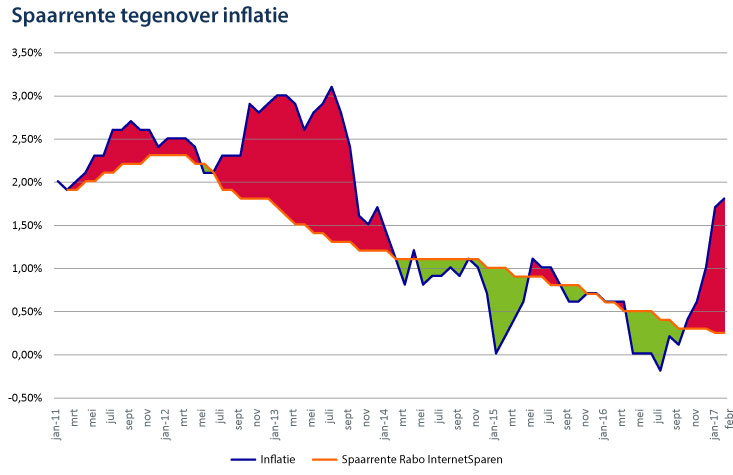
In 2008, savings rates of 5 percent were perfectly normal. Today, such an interest rate is nowhere in sight. With rates just a few tenths of a percent above zero, and some already at zero, the search for alternatives is in full swing. Is saving still worthwhile given current interest rates? And why are interest rates so low? In part 1 of this two-part series, we look at these 2 questions.
Saving costs money
Interest rates have fallen sharply in recent years. Over the same period, inflation has fallen less sharply than interest rates, which means that the real interest rate (interest rate minus inflation) is negative.
This fact alone means that saving costs more money than it earns. The money you have put aside loses value, while the interest you receive on it is not enough to make up for that loss of value.
According to Hans de Jong, chief economist at ABN Amro, people therefore suffer from money illusion: "People don't really keep a close eye on inflation. If inflation is three percent and the savings rate two percent, they are content with that. But if inflation and interest rates are both close to zero, people have a huge problem with it."
Wealth tax
Besides interest versus inflation, there is another factor to consider when it comes to saving. Anyone with more than €24,437 in savings pays a wealth tax of 1.2% on that capital (30% of a notional 4% return) under Box 3, the Dutch tax on savings and investments. Up to 2017, the Dutch Tax and Customs Administration assumes a notional return of 4%, while the actual return does not come anywhere close to this notional figure.
Anyone who thinks the tax authorities will change this arrangement is in for a disappointment. Objections have been lodged en masse against the Tax Administration's scheme. Nevertheless, several courts have ruled that the savings tax may be levied. The District Court of Gelderland, for example, ruled (ECLI:NL:RBGEL:2017:1661 and ECLI:NL:RBGEL:2017:1662) that the Tax Administration is within its rights. The courts in Northern Netherlands, Zeeland-West-Brabant and North Holland previously reached a similar conclusion in 4 other cases. The lawsuits were brought by the Bond voor Belastingbetalers (the Dutch taxpayers' association), which argues that, with interest rates this low, a 4% return is unattainable in practice.
Why are interest rates so low?
The current savings rate is historically low. Statistics Netherlands (CBS) has never before published such a low savings rate for the Netherlands. The current low interest rates stem from the monetary policy of the European Central Bank, which has kept its rate fixed at 0% since March 2016 to support the eurozone economy and boost inflation.
The rate at which banks can park their money with the ECB, the so-called deposit rate, even stands at -0.4%. This means that banks such as ABN Amro, ING and Rabobank have to pay if they want to park money with the European Central Bank. This creates extra costs for them, which are increasingly passed on to customers who keep their own money with these banks (savings).
Current economic conditions therefore make saving hardly lucrative. That does not mean, however, that there are no alternatives for putting your savings to work and earning a return. We will look at this in more detail in part 2 of this two-part series.
Goudverzekerd uses cookies for an optimal shopping experience and security.
With your consent we also place cookies for anonymous analytics and loading external media (videos).
You can change your choice at any time via the .
Read more in our privacy policy.
Functional cookies
Always active — cart, session & security
Cookie settings
Functional (required)
Session, cart, CSRF protection and login status. Always active, no consent required.
Analytics
Anonymised statistics about page visits and website usage. No personal data is stored or shared.
Marketing
Personalised ads and remarketing via external parties such as Google and Meta.
External media
Videos (YouTube, Vimeo) and maps. These external parties may place their own cookies.