Last week, the silver price fell to its lowest level of the year. The price of the precious metal plunged by almost -4% intraday before closing the day with a loss of -2.5%. This brings silver's total loss to -13.4% since the price hit its high for the year in May. Is silver's fall justified, and will it fall further, or is a turnaround on the way?
What sets silver apart from other metals?
Silver differs from other precious metals because it has a dual function. The precious metal is widely used in industry, and it can also be regarded as a legitimate way of preserving wealth. Silver therefore plays a hybrid role: it has been used as a form of currency in various parts of the world for thousands of years, while also depending on the industrial market.
More than half of the demand for silver comes from industry. By comparison, only 10-15% of global demand for gold is for industrial use.
Silver is used in LED chips, mobile phones, nuclear reactors, photography, solar energy, RFID chips, semiconductors, water purification, medicines and much more. Ongoing industrial demand for silver will increase in the future, which is likely to have a positive effect on the price of the precious metal in the long term.
What the gold-silver ratio means
The gold-silver ratio indicates how many troy ounces of silver are equal to 1 troy ounce of gold. It is expressed as a number that is often out of balance, meaning that silver is either too expensive or too cheap relative to gold. Extreme imbalances in this ratio also occur, and are usually followed by big rallies (when the ratio is very high) or big sell-offs (when the ratio is abnormally low).
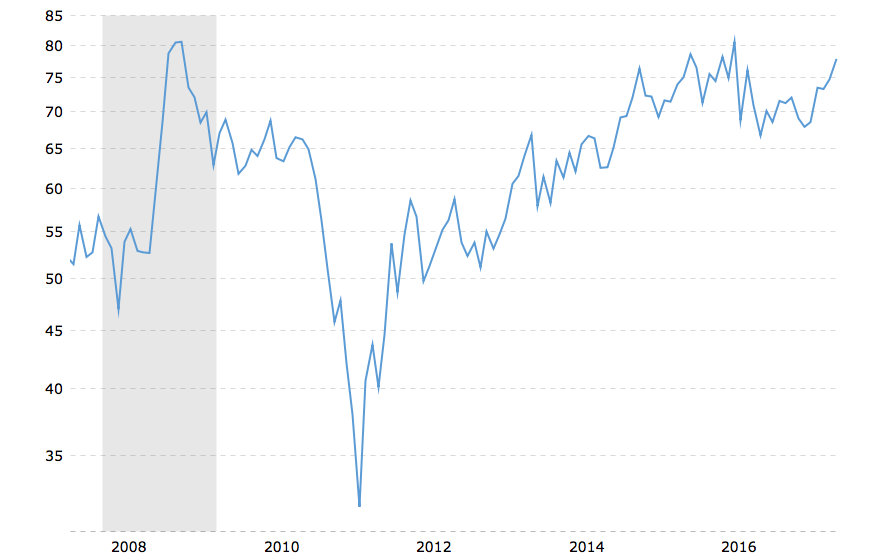
The gold-silver ratio is currently at a historically high level of 78.42. A level like this has only been seen a few times before: in 1996, 2003, 2008 and 2016. If we look at November 2008, when the gold-silver ratio touched 80, we see that the silver price exploded from $10 per troy ounce to more than $46 in about 2.5 years. Over that 2.5-year period, gold rose by around 150%, while silver gained no less than 400% in value.
The current extremely high gold-silver ratio therefore suggests that silver has the potential to break out and dramatically outperform gold.
Inflation: a key indicator for the future silver price
Many conventional indicators point to a relatively robust inflation figure in the United States. Key statistics such as the PPI (2.36%) and the CPI (2.5%) point to higher inflation than in recent years. The last time inflation was this "high" in the United States was between 2010 and 2011, when the CPI showed 2.4% for the two-year period. And it was precisely during this period that silver rose considerably in value.
Geopolitical uncertainty
One factor that the precious metals market still seems to be completely overlooking is the potential for a military conflict with North Korea. There is growing uncertainty about what the future holds with regard to North Korea and how the unpredictable Trump will deal with it. Military intervention is no longer discussed only behind closed doors, but is being openly suggested by several senior US military officers and commanders.
The most recent developments surrounding North Korea in particular will put even more pressure on Trump to act. It is hard to imagine the United States not taking action. The North Korea situation is a black swan that could significantly change sentiment towards both gold and silver and cause sharp swings in markets worldwide.
Where is the silver price heading?
The silver price shows that prices have not been this low in more than a year. Moreover, proven technical indicators show that the precious metal is extremely "oversold".
It appears that a series of factors are coming together that could serve as a solid launch pad for the silver price. The extremely skewed gold-silver ratio, inflation, geopolitical uncertainty and technical indicators all suggest that a bottom is possible in the short term, which will hopefully set the stage for an upward move in the short to medium term.
Goudverzekerd uses cookies for an optimal shopping experience and security.
With your consent we also place cookies for anonymous analytics and loading external media (videos).
You can change your choice at any time via the .
Read more in our privacy policy.
Functional cookies
Always active — cart, session & security
Cookie settings
Functional (required)
Session, cart, CSRF protection and login status. Always active, no consent required.
Analytics
Anonymised statistics about page visits and website usage. No personal data is stored or shared.
Marketing
Personalised ads and remarketing via external parties such as Google and Meta.
External media
Videos (YouTube, Vimeo) and maps. These external parties may place their own cookies.