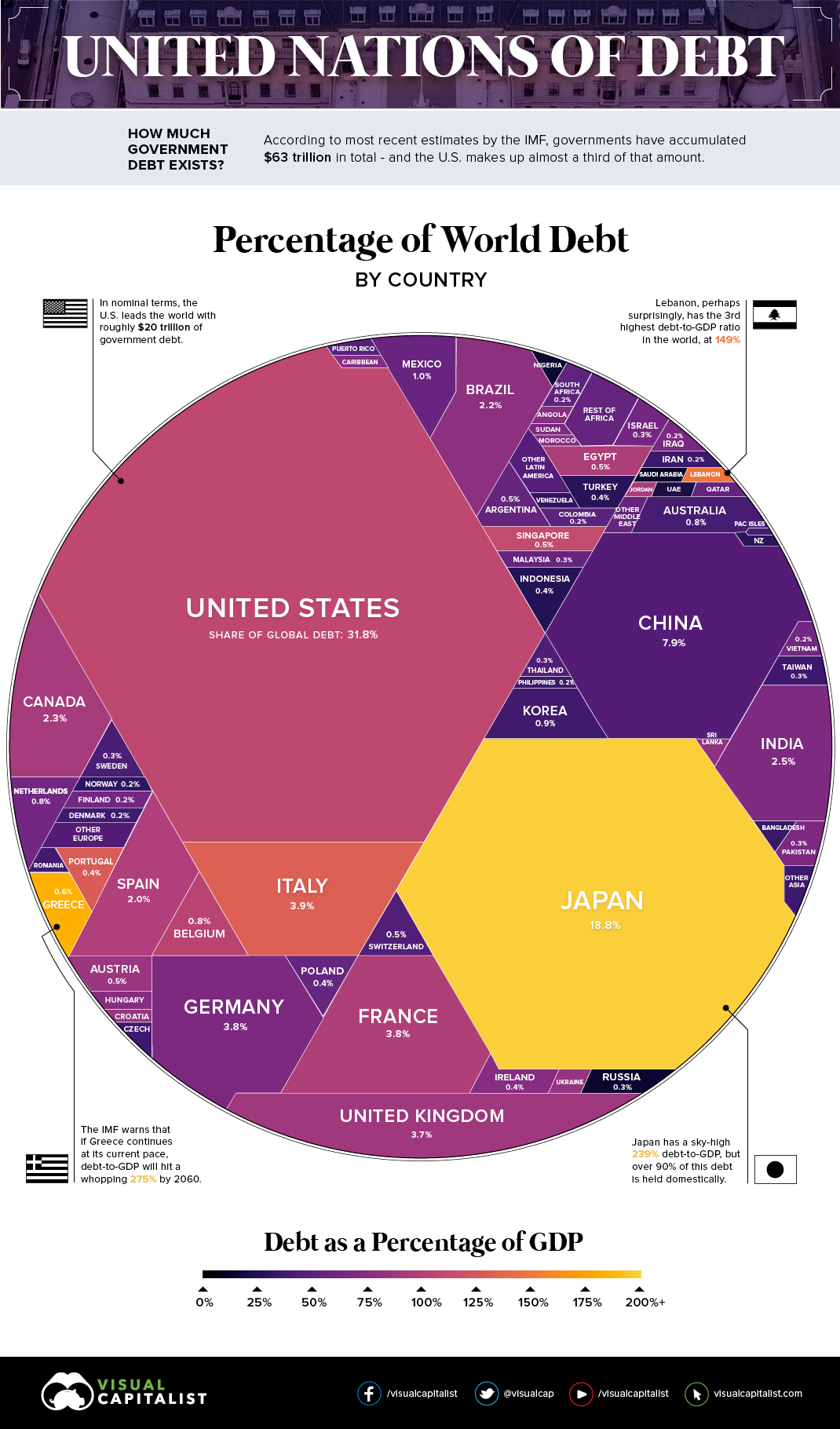
If you add up all the money borrowed by national governments, you arrive at the staggering sum of $63 trillion. That is a gigantic debt mountain of $63,000,000,000,000,000,000.
Ideally, governments borrow this money to cover short-term deficits or to finance important projects. But, as Jeff Desjardins of VisualCapitalist points out, at some point governments became used to borrowing money. Running constant deficits is seen as the new normal, making countries’ debts unsustainable. This is not healthy for the countries themselves, nor for the global economy as a whole. As a result, the debt mountain has grown explosively in recent years.
The United States is one of the prime examples of this ‘appetite for debt’. The country has not had a budget surplus since 2001, and has seen its debt rise from $6.9 trillion to $20 trillion. This corresponds to 31.8% of the total global debt mountain.
Besides the United States, the top five most indebted countries are Japan, China, Italy and France. Together, these five countries account for 66% of total global debt. Countries such as Greece, Portugal and Lebanon are also on an unsustainable path. They all have government debt higher than 130% of GDP. Especially for Greece, with all its external creditors, this is an untenable situation. The IMF has calculated that Greek government debt will reach 275% of GDP by 2060.
VisualCapitalist has created an infographic of global debt broken down by country. The percentages in the infographic show each country’s debt as a share of total global debt.
Goudverzekerd uses cookies for an optimal shopping experience and security.
With your consent we also place cookies for anonymous analytics and loading external media (videos).
You can change your choice at any time via the .
Read more in our privacy policy.
Functional cookies
Always active — cart, session & security
Cookie settings
Functional (required)
Session, cart, CSRF protection and login status. Always active, no consent required.
Analytics
Anonymised statistics about page visits and website usage. No personal data is stored or shared.
Marketing
Personalised ads and remarketing via external parties such as Google and Meta.
External media
Videos (YouTube, Vimeo) and maps. These external parties may place their own cookies.