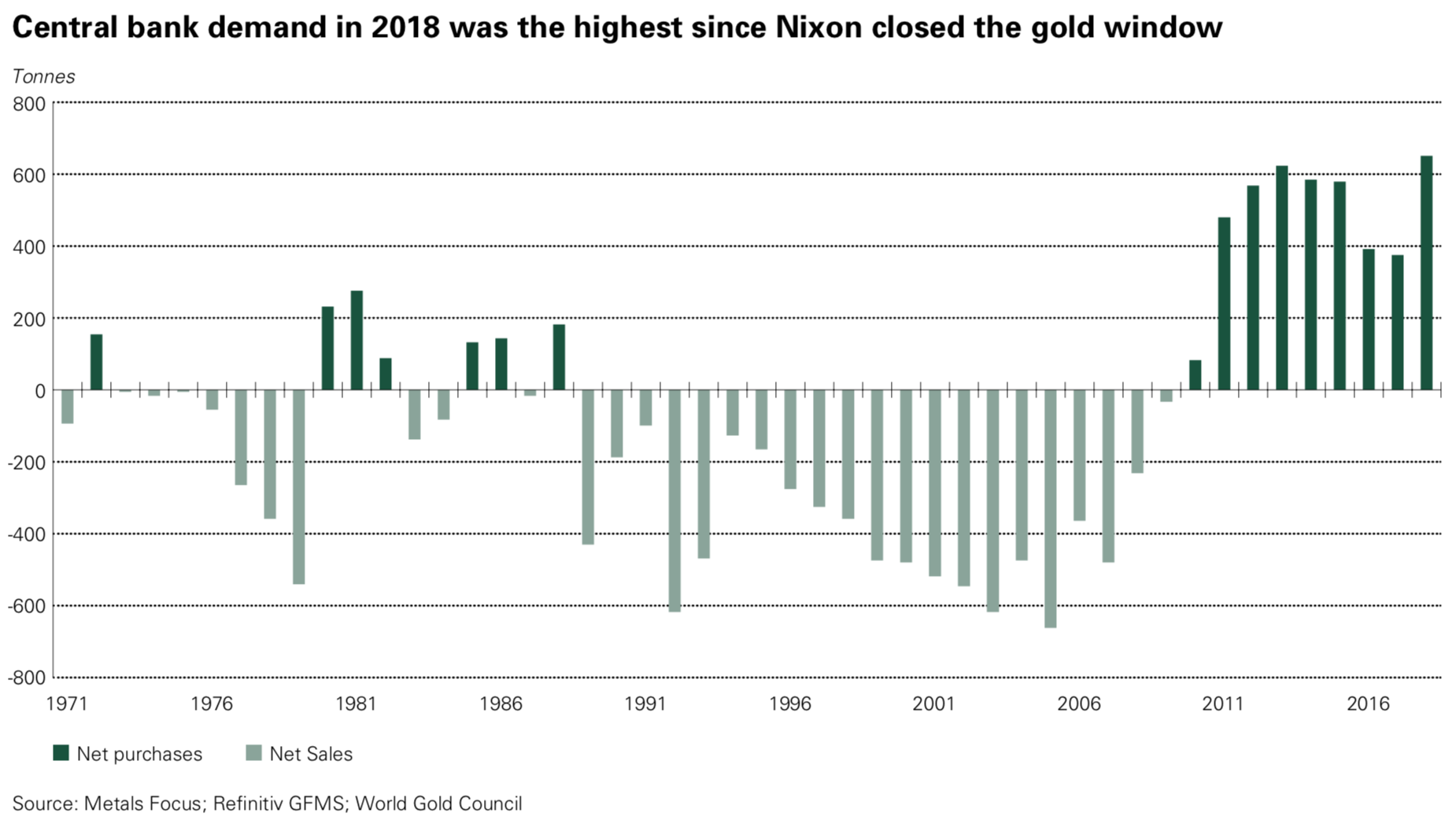
In 2018 central banks bought a total of 651.5 tonnes of gold. This is the largest annual purchase by central banks since 1971, the same year in which the US dollar was decoupled from gold, marking the end of the so-called gold standard.
The latest figures from the World Gold Council show that Russia was by far the largest buyer of physical gold. The country's central bank accounted for no less than 274 tonnes of physical gold, or 42 percent of total purchases. Russia's appetite for gold also grew by 22 percent compared with 2017.
Besides Russia, Turkey, Kazakhstan, Hungary, India, Iraq and Poland also expanded their gold reserves. According to the World Gold Council figures, China (after a 2-year pause) also bought 10 tonnes of gold in December 2018.
Central banks and gold
Central banks and gold have gone hand in hand for decades. Since the beginning of the end of the gold standard in the 1930s, many central banks have chosen to hold gold reserves. These reserves served as a safety net in times of (financial) turmoil. Gold also acted as a reserve that could be used to pay for imports if a country's own currency was not accepted by other countries.
Today we increasingly see central banks holding gold in order to become less dependent on particular currencies. The best example is Russia, which since the international sanctions imposed on it has steadily reduced its dollar reserves while working hard to increase its gold holdings.
Central banks are generally 'smart buyers' when it comes to gold. They usually buy gold before it breaks out, whereas private investors only turn to the precious metal once the price has risen exponentially or is already too high.
Goudverzekerd uses cookies for an optimal shopping experience and security.
With your consent we also place cookies for anonymous analytics and loading external media (videos).
You can change your choice at any time via the .
Read more in our privacy policy.
Functional cookies
Always active — cart, session & security
Cookie settings
Functional (required)
Session, cart, CSRF protection and login status. Always active, no consent required.
Analytics
Anonymised statistics about page visits and website usage. No personal data is stored or shared.
Marketing
Personalised ads and remarketing via external parties such as Google and Meta.
External media
Videos (YouTube, Vimeo) and maps. These external parties may place their own cookies.