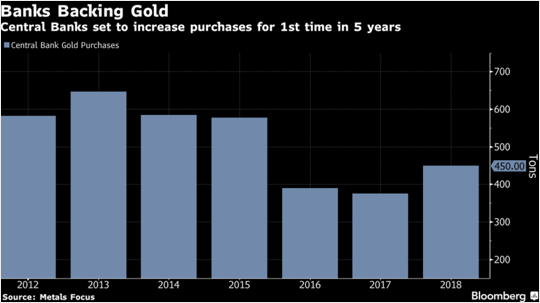
Central banks' interest in gold has been high around the world for years. Even so, central banks bought 23 percent more gold in the third quarter of this year than in the previous quarter. It is the highest level of quarterly purchases since 2015.
According to the World Gold Council, gold purchases by central banks are accelerating. New central banks have also joined the long list of countries stocking up on gold. In recent months, for example, it emerged that countries such as Poland and Hungary have also started buying gold.
Since 2017, 16 different central banks have expanded their gold holdings. Metals Focus expects total central bank purchases to reach 450 tonnes this year, up from 390 tonnes of gold in 2017 and 275 tonnes in 2016. According to Metals Focus, this brings an end to a gradual decline in central bank purchases of the precious metal.
The key players
From 2016 to the first half of 2018, most gold purchases were made by a select group of central banks, including Russia, Kazakhstan and Turkey. Since the summer, we have also seen new countries begin buying gold.
Poland, for instance, bought 14 tonnes of gold in the third quarter of this year. It was followed by Hungary, which increased its gold reserves tenfold. Bloomberg also reports that Mongolia bought 12 tonnes of gold this year, although the country itself has not yet confirmed this.
India, meanwhile, is gradually expanding its gold reserves too. This year, the country added 21.8 tonnes of gold to its holdings. It was the country's first significant purchase since it bought 200 tonnes of gold in 2009.
Why do central banks buy gold?
Central banks hold gold because gold has been regarded as money for thousands of years. Gold has a historical value in the financial system, a bond that will not simply disappear. Central banks see gold as a safety net; it underpins confidence in the fiat money system.
The reasons central banks look to gold range from geopolitical concerns to diversifying their reserves. In addition, many purchases take place when the gold price is relatively low. Many of the countries currently stocking up on substantial amounts of gold are also further reducing their US dollar reserves.
Another important factor is central banks' outlook for the future. After all, central banks are buying more gold again for the first time in five years. The chart above shows that, over the past five years, central banks bought less gold each year than in the year before.
Central banks do not seem to have much confidence in the future, or they fear rising inflation. Historically, gold has repeatedly proven to be a very suitable instrument for protecting wealth against inflation.
Central banks' appetite expected to continue
Several experts expect central bank purchases to increase even further.
Timothy Fogarty, a former senior executive at the New York Fed, says there is room for growth in central banks' interest in gold. He expects central banks to buy more gold as collateral for foreign reserves and for diversification purposes.
“Gold will always have utility as an investment asset. As an investor -central bank or not – if your portfolio grows large enough, you are going to diversify. And gold should undeniably be part of that diversification. That is classic good governance, good management”
- Timothy Fogarty - Fed
JunLu Liang, senior analyst at consultancy Metals Focus, also expects central banks' appetite to remain far from satisfied for a long time to come. She points in particular to countries such as Russia, Kazakhstan and Turkey.
“I think we may be seeing the beginning of a structural change here and we could see significantly higher purchases from central banks going forward, coupled with a further broadening in demand.”
Goudverzekerd uses cookies for an optimal shopping experience and security.
With your consent we also place cookies for anonymous analytics and loading external media (videos).
You can change your choice at any time via the .
Read more in our privacy policy.
Functional cookies
Always active — cart, session & security
Cookie settings
Functional (required)
Session, cart, CSRF protection and login status. Always active, no consent required.
Analytics
Anonymised statistics about page visits and website usage. No personal data is stored or shared.
Marketing
Personalised ads and remarketing via external parties such as Google and Meta.
External media
Videos (YouTube, Vimeo) and maps. These external parties may place their own cookies.