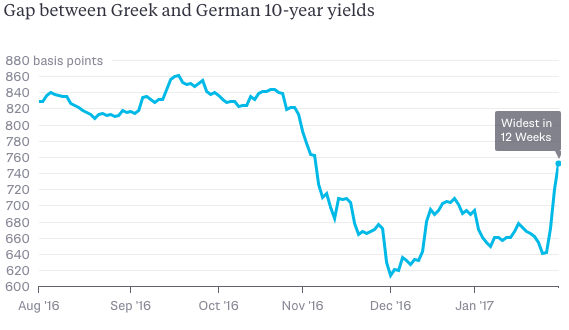
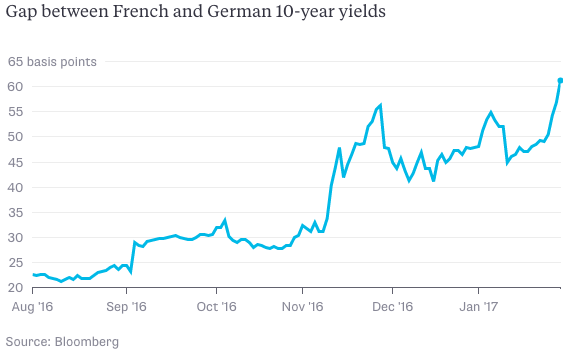
Europe is in turmoil once again, particularly Southern Europe. In recent weeks, yields on French, Italian and Greek government bonds have risen extremely sharply.
Greece
The Greek crisis is well and truly back. Last week, a report from the International Monetary Fund (IMF) leaked in which Greek government debt was described as ‘explosive’. If the IMF is no longer willing to help with Greece's debts, the eurozone countries will also pull out.
The Greek government has honoured only a third of all the agreements made with its creditors. Athens is now refusing to cut pensions further and raise income tax. Greece's debt burden has meanwhile risen to 180% of gross national product. According to the IMF, this percentage could rise to an appalling 270% of GNP over the next 40 years.
The IMF is therefore proposing debt relief to tackle the country's problems. The eurozone countries are wary of this, fearing that the rest of Southern Europe will make the same demands.
France
The French elections are just around the corner. According to various polls, there is a good chance that Marine Le Pen will win, especially since the other presidential candidate, Francois Fillon, has come under fire over ‘Penelope Gate’. According to a French newspaper, Fillon paid his wife and children €900,000 for parliamentary work they never did.
Partly as a result, the French ten-year yield rose from 0.1% in September 2016 to 1.07% now. Because of the scandal surrounding Fillon, the polls suggest Marine Le Pen will win the first round. Fillon had been the hot favourite to take on Le Pen in the second round.
Marine Le Pen presented her programme last weekend. Among other things, it states that she wants France to leave the eurozone, bring back the French franc and have the French central bank print extra francs. This would make the currency cheaper, which would lead to inflation.
Italy
Italy's problems are also piling up. Italian unemployment remains stuck at 12%, and youth unemployment is above 40%. Consumer confidence and retail sales are falling, and early elections look increasingly likely.
In addition, all efforts to find solutions for the country's ailing banking sector seem to keep failing. In short, neither the Italian economy nor the country's banking system is managing to shake off the Southern European malaise. Italian yields rose from 1.1% to 2.25%.
European shares dumped
The precarious situation in Southern Europe has also made investors nervous. TCW, the world's largest actively managed bond fund, has scaled back its exposure to European bank shares.
According to Chief Investment Officer Tad Rivelle, European shares are “excessively risky.” The firm began reducing its exposure to European banks after the Brexit vote. Rivelle adds that there is a 50% chance of a global recession in the next 2 years. Partly because of this, any incentive to invest in Europe and the European banking sector during this period has completely disappeared.
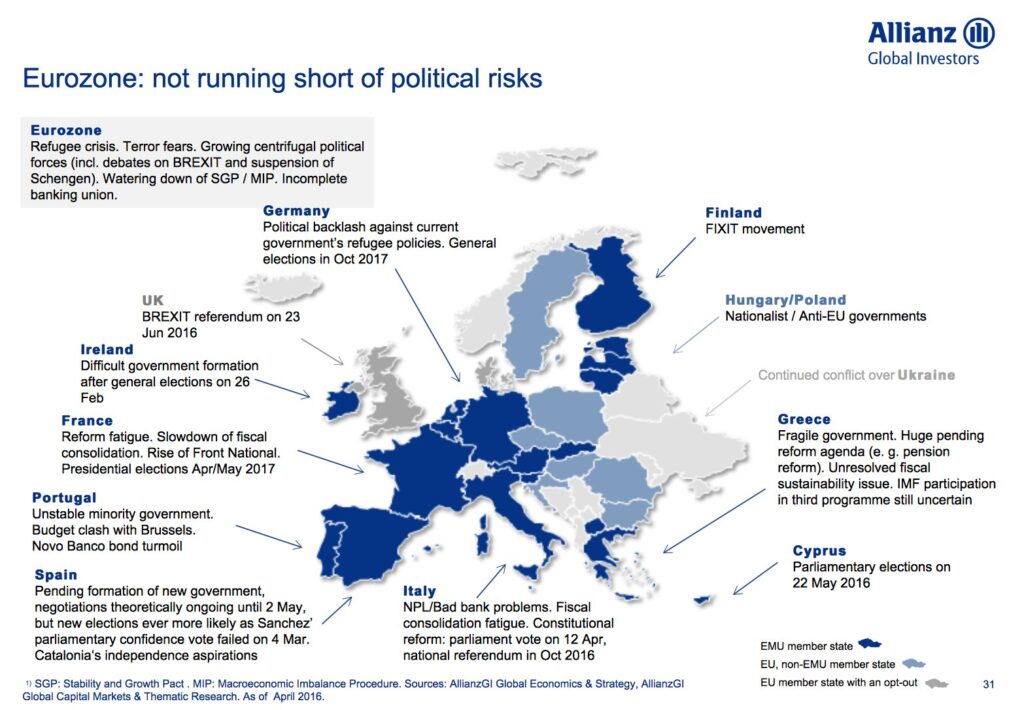
Besides the problems mentioned above, there are various other challenges elsewhere in Europe that will come to the fore this year. Below is an overview of all the key issues that will undoubtedly make for an eventful year in Europe.
Goudverzekerd uses cookies for an optimal shopping experience and security.
With your consent we also place cookies for anonymous analytics and loading external media (videos).
You can change your choice at any time via the .
Read more in our privacy policy.
Functional cookies
Always active — cart, session & security
Cookie settings
Functional (required)
Session, cart, CSRF protection and login status. Always active, no consent required.
Analytics
Anonymised statistics about page visits and website usage. No personal data is stored or shared.
Marketing
Personalised ads and remarketing via external parties such as Google and Meta.
External media
Videos (YouTube, Vimeo) and maps. These external parties may place their own cookies.